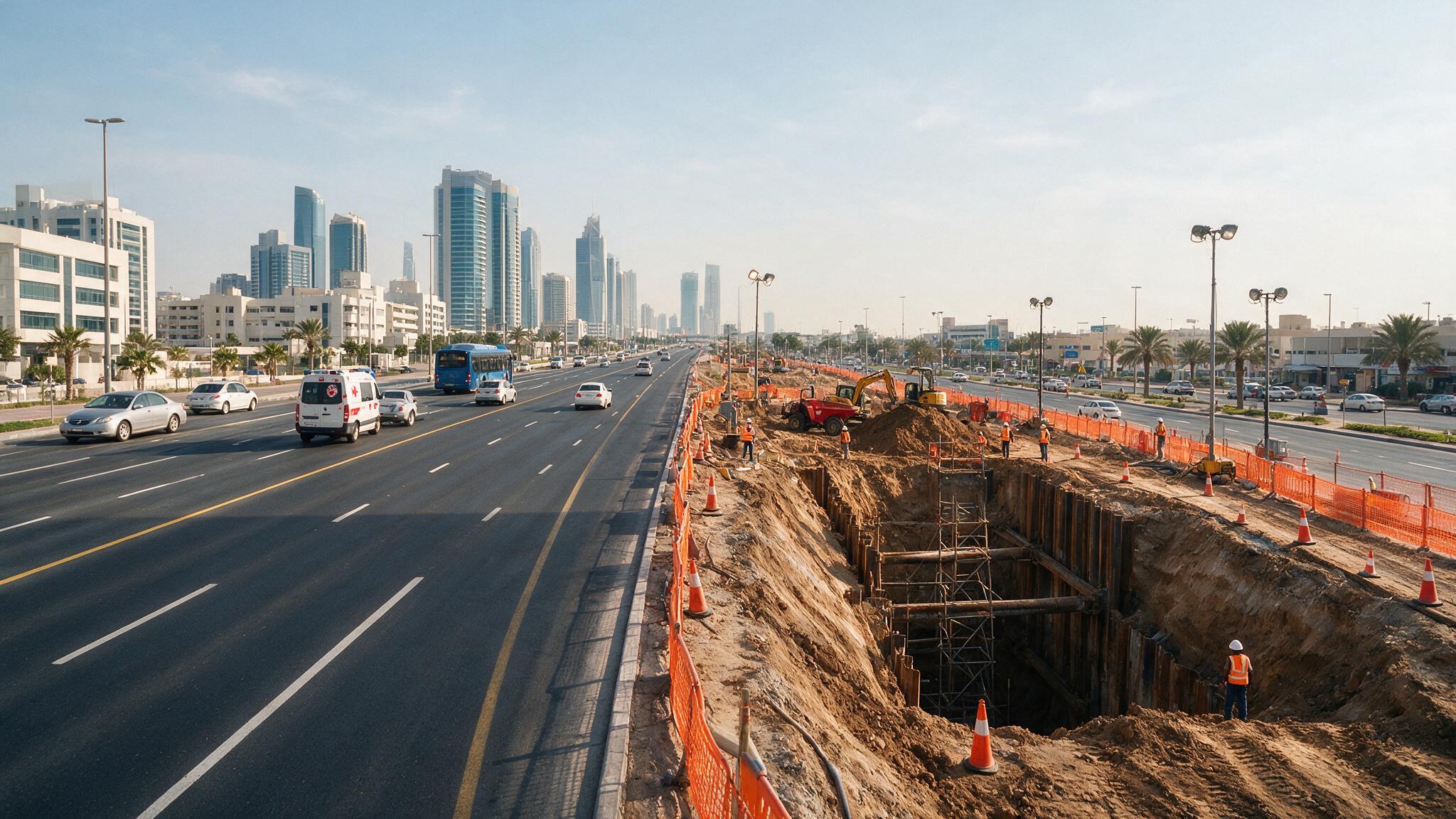

In dense urban corridors, magnetic interference makes conventional tracking unreliable. Gyro guidance changed what is possible beneath live carriageways. Here is why we standardised on it.
Every HDD bore is only as good as the answer to one question: where exactly is the drill head right now? On open ground a walkover locator answers it well enough. In a city, the question gets hard.
Conventional magnetic steering tools read the earth's magnetic field to establish heading. Urban corridors are full of things that distort that field: buried power cables, reinforced concrete, steel utilities, light rail and the traffic itself. Under a live Abu Dhabi carriageway, magnetic readings can wander enough to push a bore off its designed line, and off the line is exactly where the existing utilities are.
This is why Crossroad standardised on the ParaTrack system with its gyro module for non-disruptive road crossings. A gyroscopic tool measures heading from the rotation of the earth itself rather than from the magnetic field, which means adjacent steelwork and power cables simply do not touch the reading. Where site conditions call for it, ParaTrack can also work with a surface coil laid along the alignment, giving an independent position fix that does not depend on either magnetics or dead reckoning alone.
The practical result is confidence measured in centimetres. The driller sees true position and true heading at every rod, corrections stay small and smooth, and the as-built log handed to the client shows a bore that sits where the drawing said it would.
Precision guidance is not a luxury line item. On a congested crossing it is the difference between threading the utility corridor cleanly and finding a chilled water main the hard way. The right machine, the right people, and above all the right information at the drill head.